The most important Heuer Monaco ever to appear at auction is coming to New York this June – and, unusually for a watch so often written about, this one carries a claim that is difficult to argue with.
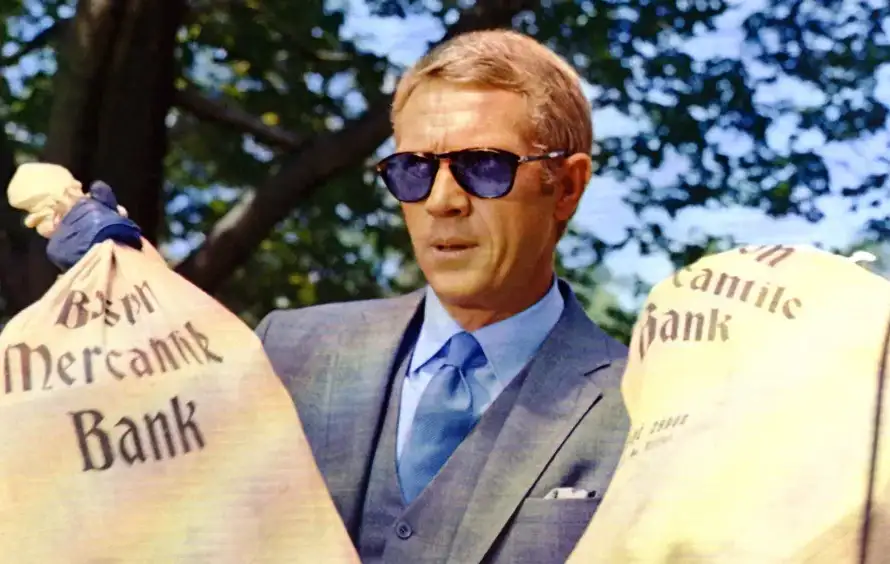
Offered by Sotheby’s as part of its Important Watches sale on 15 June, the piece is described as the example most extensively worn by Steve McQueen during the filming of Le Mans.
Of the seven blue-dial Monaco watches supplied to the production in 1970, it is the one property master Don Nunley kept for himself – and, according to his own account, the one that spent the most time on McQueen’s wrist.
“For me, this is going to make the top five watches I’ve ever been associated with,” says Geoff Hess, Sotheby’s global head of watches, and chief of world-class collectors event Rolliefest, speaking to Esquire. “It is arguably the most important Heuer on the planet.”
The backstory is unusually clean. “Our consignor bought this directly from Don Nunley,” Hess says. “He was the property master for Solar Productions during the making of Le Mans, responsible for all the props, including the watches. At the end of filming, he ended up with a handful of them. He sold them all except one – he kept the very best for himself. And according to him, this was the one worn most by Steve McQueen.”
That matters because, in auction terms, the watch aligns almost perfectly with what collectors look for. “When I think about trophy watches, there are certain boxes we like to tick,” Hess says. “Number one is provenance. We have absolute, bulletproof provenance that this was the watch worn by Steve McQueen in the film. Number two, fresh to market. This has never been seen. Our consignor bought it in 2008 and has had it tucked away since. And then, of course, there is the tie to Hollywood. So you have celebrity, fresh-to-market status and provenance all together.”
The “fresh” element is particularly important. “It is hard to put a percentage on what premium that adds,” Hess says. “But unequivocally, fresh-to-market watches are considered new discoveries, and buyers pay a premium for that. No question. If this had been sold five or six times publicly, it would have slightly less allure.”
Hess had been tracking it for some time. “I have had my eye on it for years,” he says. “I did not know it was going to become available, but I knew where it was.”
What sets this example further apart is the archive that accompanies it. “It comes with what we call a lockbox of around 400 documents and perhaps 200 photographs,” Hess says. “In essence, you are buying a Heuer museum. I have never seen any watch with this much documentation – receipts, letters, all kinds of material.” Much of it comes directly from Nunley, including a detailed account of how the watch was selected.
That story has since become part of watch folklore. McQueen initially chose an Omega Speedmaster. Nunley intervened. “If you are wearing a Heuer patch, you need a Heuer watch,” Hess says. “Apparently McQueen had originally chosen the Speedmaster, and it was Nunley who insisted it should match. You can imagine what that one decision led to – all the Monaco reissues, the imagery. It has played a huge part in making Heuer a far more prominent brand.”
At the time, the Monaco was an outlier. Introduced in 1969, it was among the first automatic chronographs and one of the earliest water-resistant square-cased watches. Its shape was the point – a deliberately graphic, modern object that stood apart from the round sports watches of the era. “When you think of a square Heuer, you think Monaco,” Hess says. “This is as iconic as it gets.”
The surviving watches from the Le Mans production have gradually surfaced. Three were retained by Nunley; two have since traded hands, with one now held in the TAG Heuer museum. Another example – believed to have been used in pre-production – sold at Sotheby’s New York in 2024 for $1.4 million. This latest watch is the last of Nunley’s pieces to come to market, and the most directly associated with McQueen himself.
Since 1985, when Heuer was acquired and became Tag Heuer, the Monaco has been repeatedly revisited – its square case and blue dial returning in limited editions and campaigns built around McQueen’s image. Few watches are so closely tied to a single moment.
Conservatively estimated at $500,000–$1 million [£370,000 – £740,000] this example arrives with a different kind of weight. Not just rarity, but narrative – or, as Hess puts it, “an extraordinarily special watch” – a piece of film history whose significance extends well beyond the wrist.